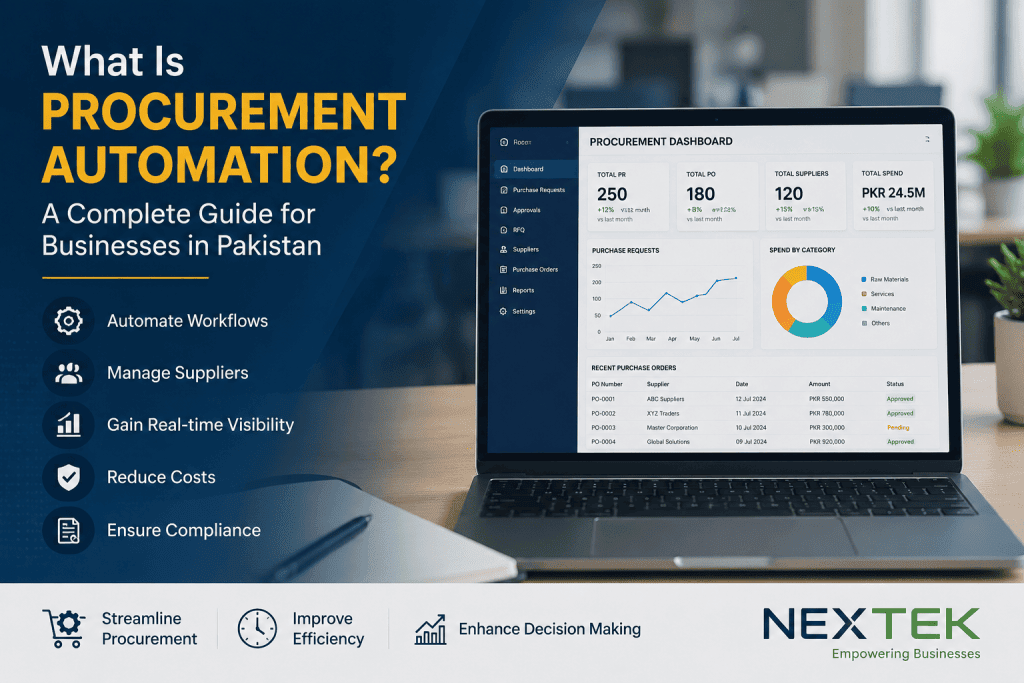
Procurement Software in Pakistan – Most procurement teams in Pakistan still run purchasing through the same three tools: email, WhatsApp, and Excel. A purchase request gets typed into a message, RFQs go out one supplier at a time, quotations come back in inconsistent formats, and someone manually rebuilds a comparison sheet before an approval chain begins over email threads that are impossible to audit later. It works, until the business scales past a handful of vendors, then it becomes the slowest, least visible part of the operation.
This guide covers what procurement management software actually does, what Pakistani businesses specifically should evaluate before buying one, and how companies like Hamdard Laboratories, Barrett Hodgson Pakistan, Amreli Steels, and Helix Pharma have already made the switch to digital procurement.
Why Procurement Is Becoming a Priority for Pakistani Businesses
A few forces are pushing procurement up the priority list for manufacturing, pharmaceutical, FMCG, and trading businesses across Pakistan:
- Rising input and import costs mean every rupee of unmanaged spend has a bigger impact on margins.
- Supply chains have widened — most mid-size and enterprise buyers now juggle dozens of vendors across multiple cities, which manual RFQ processes can’t scale to.
- Regulated sectors like pharmaceuticals face growing pressure — including oversight from bodies like DRAP — to show clean, auditable purchasing records, not just for regulators but for global partners and quality certifications.
- ERP adoption (SAP, Oracle, and local systems) has grown, but procurement — the part of the business that touches the most external parties — is often the last process still running outside the ERP, in inboxes and spreadsheets.
Together, these trends are why “procurement software,” “e-procurement software,” and “spend management software” have become active search terms among Pakistani finance directors, supply chain managers, and business owners rather than a niche enterprise concern.
The Real Cost of Manual Procurement
Before comparing tools, it’s worth being specific about what manual procurement actually costs:
- Time: procurement staff spend hours chasing suppliers for quotations instead of sourcing or negotiating.
- Money: spreadsheet-based comparisons are error-prone, and inconsistent quotation formats make it easy to miss the best rate.
- Compliance risk: email-based approvals leave no reliable audit trail — a serious problem for pharma, healthcare, and any business preparing for external audits.
- Transparency: without a structured system, vendor selection can look — or actually be — subjective, which erodes trust with finance and management.
- Data fragmentation: purchase data sitting in inboxes never reaches the ERP, so finance and procurement are always reconciling two different pictures of spend.
What to Look for in Procurement Software (Pakistan-Specific Checklist)
Generic “best procurement software” lists are written for US and European buyers. Here’s what actually matters when evaluating options for a Pakistani business:
1. RFQ and Quotation Automation
The software should let you issue a Request for Quotation to multiple suppliers at once, set a deadline, and collect responses in one standardised format — not as scattered email replies or WhatsApp messages that someone has to retype. This is also where purchase requisition software and RFQ software overlap: the request should flow straight from requisition to quotation without manual re-entry.
2. Purchase Order Automation and ERP Integration
Look for software that can generate a Purchase Order automatically once a quotation is approved, and that connects to whatever ERP you already run (SAP, Oracle, or a local system) through REST APIs, so procurement data flows into finance without manual re-entry.
3. Approval Workflows and Audit Trails
Every purchase request, RFQ, rate comparison, and PO should move through a configurable approval hierarchy, with a timestamped record of who approved what and when. This is the single biggest gap manual procurement leaves — and the one auditors and regulators care about most.
4. Vendor and Supplier Management
A central, searchable supplier management system with performance history beats a vendor list buried in someone’s inbox. Good vendor onboarding software also makes bringing in new suppliers and evaluating existing ones far faster.
5. Data Hosting, Security, and Local Support
This is where Pakistan-specific evaluation matters most. International platforms are often priced in USD, support customers from a different time zone, and may not clarify where your procurement and supplier data is hosted. A platform with local support and clear data practices is easier to get live, and easier to get help from when something breaks at 6 PM Karachi time.
6. Fit for Your Industry
Pharmaceutical and healthcare buyers need audit-ready records for regulatory and quality purposes. Manufacturing and textile buyers typically need to manage high supplier counts and recurring raw-material sourcing. FMCG buyers need to move high volumes of purchase orders quickly without losing approval control. Software built around generic templates instead of Pakistani industry workflows tends to require expensive customisation to fit any of these.
Procurement Software Options in the Pakistani Market
Broadly, businesses in Pakistan choose between three categories:
- Global enterprise suites (SAP Ariba, Oracle Procurement Cloud, JAGGAER) — powerful and deeply featured, but built for large multinational deployments, with long implementation timelines, USD pricing, and limited hands-on local support.
- Global mid-market e-procurement SaaS (Precoro, Procurify, and similar) — more accessible pricing and modern interfaces, but not built around Pakistani business workflows, tax formats, or support hours.
- Pakistan-built platforms, such as ePurchase — a B2B procurement platform designed specifically around how Pakistani manufacturing, pharma, and trading companies actually run purchase requests, RFQs, approvals, and POs, with local implementation and support.
For most Pakistani mid-size and enterprise buyers, the deciding factor isn’t feature count — it’s how quickly the platform fits existing approval structures and ERP setups without months of customisation, and how easy it is to get a human on the phone when procurement is stuck.
It’s worth noting this comparison is about private-enterprise procurement. Public-sector buyers in Pakistan operate under separate rules set by the Public Procurement Regulatory Authority (PPRA), a different compliance framework from the vendor-selection and ERP-integration criteria enterprise buyers should focus on here.
How ePurchase Is Helping Pakistani Enterprises Digitize Procurement
ePurchase, built by NexTek Global, is a cloud-based procurement automation platform that digitizes the full purchasing cycle — Purchase Requests, RFQs, supplier quotations, rate comparison, approval workflows, and Purchase Orders — from a single dashboard, with REST API integration into existing ERP systems.
Rather than asking Pakistani businesses to adapt to a template built for a different market, ePurchase is built around the purchasing workflows already used by manufacturing, pharmaceutical, and trading companies here. That local fit shows up in the results:
- Hamdard Laboratories and Hamdard University both selected ePurchase to digitize their procurement operations, extending the platform from industrial purchasing into a campus procurement environment.
- Barrett Hodgson Pakistan and Helix Pharma — both operating in regulated pharmaceutical manufacturing — use ePurchase to replace manual RFQs and spreadsheet comparisons with an audit-ready digital process, supporting the compliance documentation regulated buyers need.
- Amreli Steels uses ePurchase to bring transparency and structure to high-volume industrial procurement.
These aren’t hypothetical use cases — they’re the kind of verifiable, named case studies that are difficult for internationally-focused competitors to match in the Pakistani market, and they’re a large part of why ePurchase content ranks credibly against much larger global procurement brands.
How to Evaluate and Switch to Procurement Software
If you’re moving off manual procurement, a phased approach works better than a single big-bang rollout:
- Map your current process end-to-end — from purchase request to PO — and mark where the delays actually happen.
- Shortlist two or three vendors that offer a live demo rather than a slide deck, and test them against your actual approval hierarchy.
- Confirm ERP integration up front for your cloud-based procurement software — ask specifically how PR, RFQ, and PO data will sync with your finance system.
- Run a pilot with one department or one supplier category before rolling out company-wide.
- Plan training for procurement, finance, and supplier-facing teams together, since all three touch the new workflow.
- Go live in phases — for example, RFQs and quotations first, then approvals and PO generation — rather than switching every stage at once.
Frequently Asked Questions
What is procurement software?
Procurement software is a digital platform that manages the purchasing cycle — purchase requests, RFQs, supplier quotations, approvals, and purchase orders — in one system instead of email, spreadsheets, and manual paperwork.
How much does procurement software cost in Pakistan?
Pricing varies by vendor and deployment size. Global enterprise suites are typically priced in USD with implementation costs on top, while Pakistan-based platforms like ePurchase offer subscription plans suited to local business scale. It’s worth requesting a direct quote based on your user count and required integrations.
Can procurement software integrate with SAP or Oracle ERP?
Yes — most modern procurement platforms, including ePurchase, offer REST APIs that connect purchase requests, approvals, and purchase orders directly with SAP, Oracle, or other ERP systems, avoiding duplicate data entry.
Is cloud-based procurement software secure for Pakistani businesses?
Reputable platforms use encrypted data transfer, regular backups, and access controls. When evaluating a vendor, ask directly where data is hosted, how backups are handled, and what authentication options (such as multi-factor login) are available.
Which industries in Pakistan benefit most from procurement automation?
Pharmaceutical and healthcare companies benefit from audit-ready compliance records; manufacturing and textile companies benefit from managing large supplier bases; and FMCG and trading companies benefit from faster, higher-volume purchase order cycles.
What’s the difference between procurement software and an ERP system?
An ERP system manages company-wide operations — finance, inventory, HR, and more. Procurement software focuses specifically on the buying cycle: RFQs, supplier quotations, approvals, and purchase orders. Most businesses run both together, connecting procurement software to their ERP through an API rather than replacing the ERP.
Getting Started
Manual procurement doesn’t fail all at once — it just quietly costs more time, more margin, and more compliance risk every quarter it continues. If your team is still comparing supplier quotes on spreadsheets or chasing approvals over email, the fastest way to see the alternative is a live walkthrough of how ePurchase handles your actual purchasing workflow.
Explore ePurchase’s full feature set, or contact the NexTek team directly to schedule a demo. You can also browse more procurement and enterprise software insights on the NexTek blog.